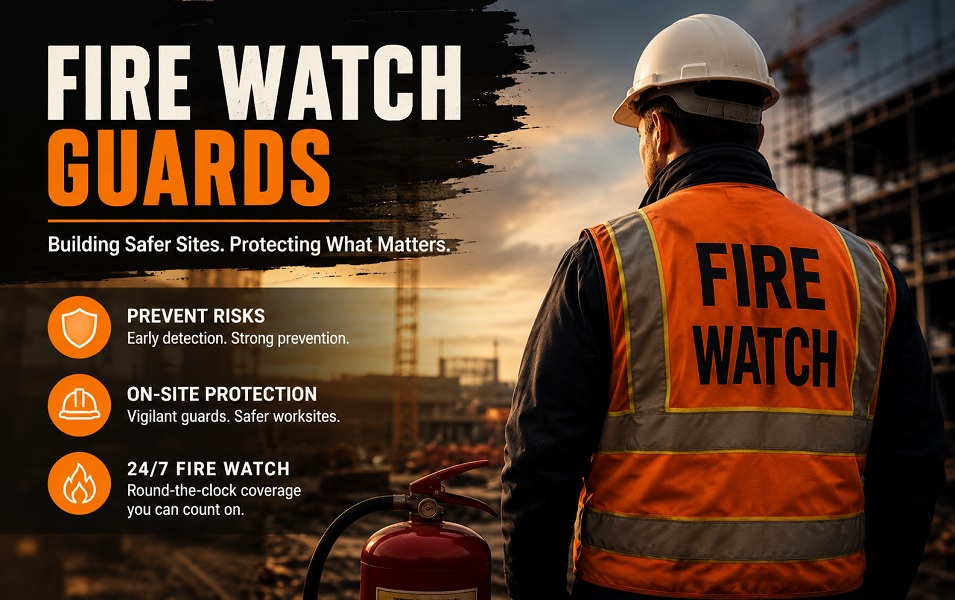
There’s a moment on every construction site, in every aging commercial building, in every facility running hot work operations, when the standard fire protection infrastructure quietly fails. The sprinkler system goes offline for maintenance. The fire alarm is temporarily disabled during a renovation. And in that window — that gap between operational safety and exposed risk — most companies do nothing. Fire Watch Guards exist precisely for that gap, and yet, a shocking number of businesses treat them as an afterthought.
The oversight is costly. Not just financially, but in human terms.
The Role Nobody Talks About — Until Something Burns
Ask most facility managers what a fire watch guard does, and you’ll get a vague answer involving someone standing around with a radio. That’s the misconception that has quietly undermined fire safety protocols in industries from manufacturing to hospitality for decades.
A fire watch guard is a trained safety professional deployed to monitor properties for fire hazards when standard fire suppression and detection systems are unavailable, undergoing maintenance, or operating below code. Their presence is triggered by specific conditions — a sprinkler system that’s been offline for more than four hours, active welding or cutting operations, electrical hazards from water damage, or direct mandates from local fire authorities.
These aren’t rent-a-cops handed a clipboard. The best fire watch professionals understand fire behavior, building layout, suppression equipment, emergency communication protocols, and the specific vulnerabilities of the environment they’re watching. That’s a fundamentally different skill set from general security work, and companies that conflate the two are setting themselves up for catastrophic liability.
What OSHA Doesn’t Tell You (But Should)
Regulatory bodies like OSHA have established clear frameworks for fire watch operations, particularly around hot work environments — welding, torch cutting, soldering, and grinding. The rules exist. The enforcement, however, is inconsistent. And many businesses discover the gaps in their compliance only when an incident has already occurred.
Under most state and municipal fire codes across the United States, fire watch services are a legal requirement any time a building’s fire detection or suppression systems are non-functional. This isn’t optional guidance — it’s a mandate backed by inspections, insurance requirements, and potential citations. Fire marshals can and do levy heavy fines against facilities found to be operating without required fire watch coverage.
What OSHA and local ordinances don’t emphasize loudly enough is the documentation burden. Fire watch guards are required to maintain detailed, time-stamped patrol logs. These records note identified hazards, corrective actions taken, patrol frequency, and supervisor sign-offs. Insurance companies review these logs. Lawyers examine them in litigation. Yet many businesses treat fire watch documentation as a formality rather than the legal shield it actually is.
High-Risk Industries That Depend on Fire Watch Services
The industries that rely most heavily on fire watch services share a common trait: environments where combustion conditions can escalate faster than automated systems can respond. Construction sites, where raw framing and scattered flammable materials create a tinderbox during the build phase, are the most obvious use case. But the picture is broader.
Manufacturing facilities running continuous hot work operations deploy fire watch personnel as a permanent operational layer, not a temporary fix. Hospitals undergoing renovations face a particularly complex challenge — they can’t simply evacuate patients while fire systems are offline, which makes consistent fire watch patrol an operational necessity. Hotels, concert venues, warehouses storing hazardous chemicals, and data centers with elevated electrical risk all share the same exposure.
Large public events held in facilities that aren’t fully up to code represent another underappreciated risk category. A packed venue with a partially functional alarm system and no fire watch presence isn’t just a liability — it’s a preventable tragedy waiting for the wrong night.
The Five Duties Most Companies Underestimate
The gap between what businesses expect from fire watch guards and what effective fire watch service actually involves is wide. Most companies imagine the role as passive observation. The reality is procedural, technical, and continuous.
Regular, documented patrols — typically every 15 to 30 minutes across the full property — form the operational core of fire watch work. Guards aren’t stationary. They move through high-risk zones, check storage areas for flammable materials, look for blocked emergency exits, inspect wiring for overload or damage, and log everything. A single missed patrol can create a window in which a smoldering hazard becomes an active fire.
Beyond patrol, fire watch personnel monitor suppression equipment directly. They verify that fire extinguishers are accessible, properly labeled, and within service dates. They check that hoses are mounted and functional. They ensure that emergency lighting is operational and that evacuation routes are clear. These checks aren’t ceremonial — in many jurisdictions, they’re legally mandated and subject to audit.
Communication infrastructure is the third pillar. A fire watch guard must maintain live communication links with local fire departments and internal emergency response teams. When smoke is detected or a hazard escalates, the first call happens within seconds — not minutes. That responsiveness is the entire value proposition of having a human presence rather than relying solely on automated detection systems.
Documentation, as discussed, functions as the legal and operational record of every shift. And when an actual fire situation develops, the guard’s final and most critical duty is executing the evacuation protocol — calmly, systematically, and with accountability for every person in the building.
Why “Cheap” Fire Watch Costs More in the Long Run
The market for fire watch services in the United States has grown steadily, driven by increased construction activity, aging building infrastructure, and tightening enforcement from local fire authorities. That growth has also attracted low-cost providers who deploy minimally trained personnel without proper certification, documentation systems, or accountability structures.
The false economy of underpriced fire watch services reveals itself in predictable ways. An improperly documented patrol log leaves a company exposed during an insurance claim. A guard without proper emergency training costs precious minutes during an evacuation. A provider without established communication protocols with local fire departments can delay response by a factor that transforms a containable incident into a total loss.
Experienced providers approach fire watch differently. They invest in training, technology, and process rigor. Personnel understand not just the mechanical duties of the role but the regulatory landscape specific to each state and municipality. They’re versed in NFPA standards, IFC codes, and the specific requirements of the industries they serve.
What Sets Professional Fire Watch Services Apart
The distinguishing factor in professional fire watch operations isn’t equipment — it’s knowledge architecture. Top-tier providers train their personnel in fire prevention principles, suppression techniques, emergency communication, and property-specific orientation before a single shift begins.
They also bring continuity. A building manager who hires an ad hoc guard for a single night gets someone unfamiliar with the facility layout, the location of suppression equipment, the building’s unique hazard profile, and the chain of command for emergency escalation. A professional fire watch service onboards personnel with site-specific briefings, ensuring guards know the building before they patrol it.
This distinction matters most in complex environments — multi-story commercial buildings, active construction zones, or industrial facilities with multiple interdependent systems. The guard who knows where every extinguisher is mounted, which exit routes are currently obstructed by construction materials, and who to call at 2 a.m. is not the same as the guard who learned the building by walking it once.
The Business Case That Remains Unspoken
Risk managers at large organizations understand, at some level, that fire watch services represent a cost of doing business in high-exposure environments. But the full business case rarely gets articulated clearly in boardrooms or budget meetings.
Consider the exposure without it. A fire that starts during a lapsed alarm system — in a facility that had no fire watch coverage — creates a chain of consequences: property damage, potential casualties, business interruption, regulatory penalties, and protracted insurance battles. The litigation alone in such a scenario frequently dwarfs the annual cost of ongoing fire watch coverage by orders of magnitude.
Beyond loss prevention, there’s the less-discussed benefit of operational continuity. When fire suppression systems go down for maintenance or repair, fire watch guards enable businesses to keep operating legally and safely rather than shutting down entirely. For manufacturing floors, hotels, and hospitals running around the clock, that operational continuity has direct and measurable financial value.
The companies that understand fire watch guards as a strategic operational asset — rather than compliance checkbox — are the ones that never make headlines for the wrong reasons. And in this industry, staying out of the news is the entire point.
The Standard Has Changed — Has Your Company Caught Up?
The fire safety landscape in the United States is not static. Municipal fire codes are being updated. Insurance underwriters are raising the bar on documentation requirements. Post-pandemic construction booms have dramatically increased the number of sites requiring temporary fire protection measures. And regulators are paying closer attention.
The businesses that will absorb fines, face liability exposure, and — worst of all — experience preventable incidents are overwhelmingly the ones that haven’t recalibrated their approach to fire watch services. Not because they’re reckless, but because they never fully understood what a properly deployed fire watch program actually looks like.
Getting there isn’t complicated. It starts with honest assessment — which of your facilities currently operates with compromised fire detection infrastructure? Which operations involve hot work or high combustibility risk? Where are your documentation practices genuinely compliant, and where are they performative? Those answers form the baseline. Everything else builds from there.